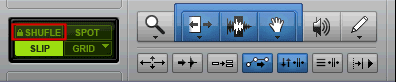
Use "Shuffle Lock" to prevent accidental editing while in Shuffle Mode.
To engage Shuffle Lock:
Press and hold down the Ctrl key on your keyboard.
Left click on the 'Shuffle' edit mode button of the Edit Window Tool Bar. A small lock will appear to the left of the Shuffle button. See the image below.
NOTE: You cannot enable Shuffle Lock while in Shuffle mode.
These tips enable you to easily and quickly scroll left (earlier) or right (later) on the Pro Tools timeline.
You need a mouse with a middle scroll wheel or a track pad to use method 1 below. Method 2 uses keyboard keys only.
Method 1:
Press and hold down the SHIFT key on your keyboard.
Rotate your mouse scroll wheel forward to move left (backward) on the timeline.
Rotate your mouse scroll wheel backward to move right (forward) on the timeline.
Method 2:
Press and hold down the ALT key on your keyboard.
Press the Page Up key to move left/earlier on the timeline.
Press the Page Down key to move right/later on the timeline.
If you have a lot of visible tracks in a session, it can be useful to change to a narrow mix view to reduce the width of the tracks. This makes the session feel less cluttered. You can also fit more tracks in the same viewable space of the Pro Tools mix window.
Narrow or Expanded Mix Window View
Press and hold down the CTRL + ALT + the M keys on your keyboard.
Pressing the M key allows you to toggle between Narrow or Expanded view.
Left-click on the Show/Hide icon of any track in the Track List.
NOTE: The Track List is located at the top left of the Pro Tools Edit and Mix windows. The track Show/Hide icon is the black dot to the left of a track name in the Track List. I've drawn a red square around the Show/Hide icon in the image below.
Left-click on an Edit window view name to remove the view.
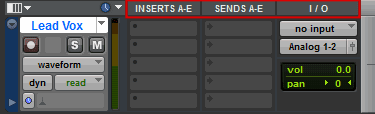
The image below has three different Edit window view names showing. The names are INSERTS A-E, SENDS A-E and I/O. I've drawn a red line around all 3 window view names in the image below.
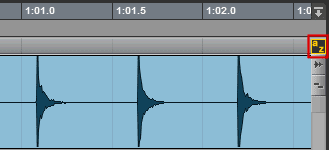
Left-click on the Commands Keyboard Focus button (a/z) at the upper right corner of the Pro Tools Edit window. I've drawn a red line around it (enabled) in the image below.
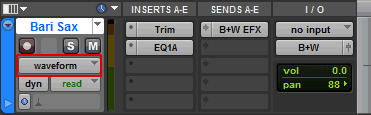
Left-click on the "Track View" selector button or dropdown arrow. They are located below the track name in the Edit window. (surrounded in red within image below)
Route a Track Output to Multiple Inputs (Bus or Physical Output):
Press and hold down the "Windows" key (has the Windows logo on it).
Left-click on the track's output path selector button located under the I/O (Input/Output) section of the track.
Choose where you want to route the signal (for example a bus or physical output).
You will notice a + sign added to the left of the tracks output path selector button. The +/plus symbol indicates the track output is routed to more than one location.
Press the CTRL key then the number 4 on the numeric keypad of your keyboard.
The automation window shows the different types of automation that are currently enabled. You must enable any automation type you want to write. Enable automation by left-clicking on the button (turns red) for the automation type you want to enable.
Press and hold down the CTRL + SHIFT + the letter G key on your keyboard. While holding down the CTRL and SHIFT keys, the G key can be used to toggle the suspend state from enabled to disabled.
Video Created by JOEL CAMERON - Transcribed by TOM BOWSER
Why do we want to reduce/eliminate the snare and cymbal leakage into the kick mic/track? Anything done to the kick drum mic/track (EQ for example) will also be done to the snare drum and cymbal leakage. The result of processing the leakage can cause drums to sound indistinct and can cause strange frequency interactions.
EQ changes to the bass/kick drum will affect the sound of the drum and cymbal tracks present in the leakage which becomes noticeable when these tracks are added to the entire mix.
In this tutorial, we compress the external bass/kick drum mic. We will create a send from the snare drum to trigger the compressor on the kick. This will reduce the level of the snare present in the bass/kick drum track. This approach also allows you to keep all the kick/bass drum resonance the outside microphone captures. If you use an Expander / Gate you may lose some of the bass/kick drum resonance.
NOTE: If the ATTACK and RELEASE times are too fast you may hear distortion. The distortion will sound like crackling. Increase the ATTACK and RELEASE times to eliminate the distortion. You may also have to reduce the amount of compression by reducing the THRESHOLD.
Instantiate a compressor on the external kick drum mic/track.
Create a pre-fader send (click on the PRE button on the track) on the top snare track and send the snare signal to an unused bus.
Name the bus TOP SNARE SEND.
Choose the bus selected in the previous step (TOP SNARE SEND) as the key input of the compressor on the kick/bass drum track.
Enable the SIDE-CHAIN of the compressor by clicking on the tiny key in the SIDE-CHAIN section of the compressor. You can click on the tiny speaker to listen to the side-chain signal (it should be the snare) that the compressor is now using to trigger the compressor.
Set the compression RATIO to 6 or so. Adjust as needed/desired.
Speed up the ATTACK time from the default of 10ms to the compressors fastest setting (turn the ATTACK control fully counter clockwise) or lower to remove the attack/snap of the snare. If you hear crackling/distortion you may have the attack time too fast. Slow it down (turn the control/knob clockwise).
Set the RELEASE at around 250ms or what sounds right for the music. For a more natural sound watch the GR meter to set a release speed that seems natural to the speed of the music.
Adjust the THRESHOLD to the point you are seeing - 6 to -18 of gain reduction. This allows you to keep the sustain of a double headed kick drum (with both heads on while it was tracked).
Any additional leakage left after using this approach may be able to be removed using a LP (low pass filter) or other EQ.
NOTE: The speed of sound is approximately 1100 feet per second so about 1 foot per millisecond. The mic that is in front of the bass drum is probably around 3 feet from the snare mic. When the snare drum gets hit it takes about 3ms to reach the external kick mic.
By keying the compressor off of the snare's top mic and then using a pretty fast attack you can compress BEFORE the snare leakage reaches the mic. This allows you to effectively remove or at least significantly reduce the snare leakage in the external kick mic/track.
You will see greater headroom in the external kick drum track allowing you to raise the fader and achieve greater volume of the track in the mix.
Video Created by JOEL CAMERON - Transcribed by TOM BOWSER
What are ghost notes? Ghost notes as they pertain to the drums are quiet notes usually played in between accented notes. They do not always have to be played in between accented notes. Ghost notes can be used to fill in the groove and give it more feel, rather than the groove sounding very straight and rigid.
Ghost notes may be more felt than heard. Musicians on the stage who are playing with the drummer may be able to feel the ghost notes and lock with the drummer better because the drummer is filling out the groove more and giving it more feel.
If ghost notes are present in the track you want them brought out and heard. If there is no ghosting you do not need to use this technique because the back beat will be the loudest thing in the track and will be the most audible over any leakage in the track (the kick for example).
Use compression to help the ghosting be heard:
Instantiate a Pro Tools Compressor/Limiter Dyn 3 on the bottom snare track.
Use a really fast ATTACK TIME (10.0us or so). To reduce the attack time (make it faster) turn the ATTACK knob on the DIGI Compressor / Limiter counterclockwise. With this approach we are going to try to even out the amount of snare response from the ghosting as from the snare heads.
Increase the RATIO to around 8 to 1 so it's compressing pretty dramatically.
Increase the RELEASE time from the default of 80ms to 160 to 180ms.
Increase the GAIN as needed.
Looking for total compression of -12 dB or so.
Optional:
The bottom of the snare may be rattling just as much when the bass/kick-beater hits as it is with the strike of the drumstick. We can limit how much of the kick/bass drum we hear in the bottom snare mic using the following procedure.
Create a pre-fader send (click on the PRE button) on the inside kick channel. Route the kick send/signal to an unused bus. Label the bus "KICK IN SEND".
Instantiate a second compressor after (in serial) the first compressor on the bottom snare track (see above directions).
Set the key input of the second compressor to the bus chosen for the kick drum send (KICK IN SEND).
Enable the side-chain of the second compressor by clicking on small key located in the SIDE-CHAIN section of the DIGI Compressor / Limiter. Click on the tiny speaker to the right of the small key in the SIDE-CHAIN section of the compressor to listen and verify the bass/kick drum signal has been routed properly to the compressors side-chain. Turn the side chain listen off once you've verified the compressor is receiving the kick's send.
Increase the ATTACK time (as fast as possible) by turning the control/knob counter-clockwise.
Decrease/slow the RELEASE until it sounds natural (Example: 300-400 ms). Watch the gain reduction (GR) meter to get a sense of the speed of the compressors release time.
Adjust the THRESHOLD to achieve -12dB or so of gain reduction. For a more natural sound increase the THRESHOLD until you see around -6dB of gain reduction.
NOTE: Verify your settings and how they affect the sound by toggling the compressor plugins BYPASS switch.
Video Created by JOEL CAMERON - Transcribed by TOM BOWSER
You isolate the drums first using expander/gates or editing (Example, Pro Tools Strip Silence) to minimize the bleed in the track from other drums & external sources (use editing if needed, given the context of the music, the amount, and type of bleed).
Isolating the drums limits the amount of bleed that is also processed with the drums when they are processed (EQ, Compression). Also, by isolating the drums first, if the drums are well recorded you may not need to do much processing.
Isolation (with downward expansion and noise gates) is usually not done during tracking. Any mistakes in settings would be committed to the recording and could not be undone. LISTEN before drawing any conclusions.
Though it may sound good, the low end on the kick drum has to be managed, especially if there is a really rich bass guitar that will be layered with it. Why? Because the low end of the kick may trigger low frequency compression when it's getting mastered or trigger limiters used by radio stations. Kick drums need to marry well with the bass in a mix and give the rhythm articulation. The kick/bass drum and bass guitar should complement each other.
NOTE: Not much is needed to "fix" a track when the drums are tuned and recorded well.
EQ: Always begin by using subtractive EQ then use additive EQ as needed. By removing unwanted frequency content from the tracks you make more room for what you're keeping in other tracks. Using subtractive EQ first often results in needing less additive processing later to reach your desired result.
External Mic: Check the low mids (LMF) on the external mic. Reduce/dip then sweep back and forth across the frequency spectrum to find where you want to cut/reduce (as/if needed). Experiment with narrowing the Q and deepening the cut steeply to make sure you're in the right neighborhood when sweeping. Generally with external mics you may need to cut 2 - 3 dB or so around 125 to 150 Hz
Controlling the low-mids by reducing them improves the attack of the track. It also allows you to raise the level of the external mic track for a more complete, blended sound.
Internal Mic: Using subtractive EQ reduce the low mids if needed as was done with the external mic. You may need to cut 2 to 3 dB or so around 110 to 130 Hz.
Add some attack to the inside kick mic/track by boosting/increasing the HMF (high mid frequencies). Boost about 3 dB, then sweep to around 5k or so. You can narrow the Q, then boost to more precisely find the best frequency range to boost. After you find the frequency range that adds the attack that sounds good on the kick try widening the Q again. If you widen the Q you can bring the tracks overall level down because it's affecting more frequencies adjacent to the center frequency.
Listen to ensure you have the right amount of attack in the kick/bass drum tracks. By removing some LF content you are revealing the attack elements of the sound.
Expander/Gate
External Mic: If you bring up the level of the external mic its decay component will be stronger than it was at a lower level. To modify the decay component we can add an Expander/Gate and trigger it with a send to its side chain from the internal mic.
Instantiate a Pro Tools Expander/Gate Dyn 3 plugin as an insert on the external mic.
Create a pre-fader send (click on the PRE button of the send) on the internal kick drum mic/track.
Choose an unused bus and use it to route the internal kick drums send to the Key Input of the expander/gate you inserted on the external kick drum mic. If a pre fader send has already been created on the mic/track you can use it.
Choose the unused bus used for the kick drum send as the key input of the expander/gate plugin inserted on the external mic.
Enable the side-chain on the expander/gate by clicking on the little key image next to the words SIDE-CHAIN of the side-chain section of the expander/gate.
Increase the ATTACK of the expander/gate to as fast as possible to allow the transient through (turn the attack control all the way counter-clockwise to 10.0 µs).
Increase (slow) the RELEASE time (turn release control clockwise) to around 725 ms.
Increase the HOLD time to around 100 or 105ms.
Set the RANGE control to -10 to -12 or lower (-8) for a more natural sound.
Video Created by JOEL CAMERON - Transcribed by TOM BOWSER
You often do not need much of the hi-hat microphone in the mix. You can often get the amount of hi-hat you need from the overhead microphones. However, in denser mixes you may need to use the hi-hat microphone to give the hi-hat definition in the mix.
If the hi-hat mic is positioned too high when it was recorded to "let it breathe" you can get a lot of snare leakage/bleed into the hi-hat mic. If you then use the hi-hat mic/track high in the mix you tend to get a phasy/blurry snare response that's fighting the close mic on the snare.
The goal of the following section is to reduce the amount of snare sound present in the hi-hat track.
Create a "pre-fade" send on the top snare track.
Left click on a blank area under the SENDS section of the track's channel strip.
Hover your mouse over the word "bus" then left click on any unused MONO bus, for example, Bus 9 (Mono). You know a bus is not being used when the numbers (or name) that identify it are colored white. Yellow indicates the bus is being used.
Set the send level fader to 0.
Left click on the "PRE" button on the send fader. It turns blue when enabled.
Rename the bus to "TOP SNARE SEND". To rename the bus right click on the bus button then left click on "Rename…".
Insert a Pro Tools Dyn 3 Compressor/Limiter (mono) on the hi-hat track.
Enable the side chain of the compressor on the hi-hat track by left clicking on the small key in the SIDE-CHAIN section of the compressor. The small key will turn blue when the side chain is enabled. See the image after step 9.
Set the "key input" of the compressor to the bus (TOP SNARE SEND) created in step 1. Left click on the Key Input drop-down arrow (says "no key input"). Hover your mouse cursor over "bus" then left click on the TOP SNARE SEND (Mono) bus to select it. See the image after step 9.
Set the compressor's attack to 10.0 us or so (turn the attack knob full counter-clockwise) to catch/bite off the front of the transient of the snare in the hi-hat microphone/track.
Set the compressor's release to 26 ms or so. You want the compressor to release so fast you don't notice the snare drum was compressed. A fast release will also allow the hi-hat through.
Set the compression RATIO to 3/1. Experiment with a lower compression ratio of 2/1.
Adjust the THRESH (threshold) of the compressor until you see about 6 to up to 18 dB of gain reduction. When used in heavy rock where you may need to bring up the hi-hat to enable it to cut/be more present in the mix.
NOTE: The hi-hat track is being compressed, but the snare drum is triggering the compression. The snare level present in the hi-hat track will be reduced and compressed.
EQ:
Joel states that the hi-hat is a high frequency instrument. There is nothing in the way of low frequencies that we want to hear in the track. The first thing Joel wants to do is reduce the low frequencies in the track. All the low frequency information has nothing to do with the hi-hat.
Joel also states in this video that the hi-hat track has a "metallicy" character that he does not like. He states that the sound of the hi-hat in the track is either how the hi-hat itself sounds or it sounds as it does because of the microphone or preamp used or possibly the mic placement used to record the hi-hat. He decides to insert a compressor on the track to see if he can improve the sound of the hi-hat.
Insert the Pro Tools EQ 3 7-band in the hi-hat track AFTER the compressor.
Disable the LF (low frequency), LMF (low-mid frequency), MF (mid frequency) and HF (high frequency) bands of the EQ. Left click on the "IN" button to enable or disable a band. A band is enabled when the "IN" button is blue.
Enable the HPF (high pass) filter and set it to 6dB/oct (this should be the default).
Sweep (slowly turn the FREQuency knob from left to right) the HPF FREQ knob from its default at 20.0 Hz up to 450-750 Hz to reduce the low end present in the hi-hat track. (Joel eventually sets it to 768.5 Hz in the video)
Cut using the high mid filter (HMF) to reduce the level in this frequency range if the hi-hat sounds tinny or harsh (often a problem that results from using cheaper solid state microphones). You may want to sweep (turn the FREQuency knob from left to right then right to left) and listen to find the frequency range you want to reduce. In the video Joel reduces by -2.7 dB at 12.62 KHz. You want to use what works on your hi-hat track.
Bypass the EQ and listen then re-enable the EQ to verify the difference in the hi-hat track both with and without the EQ.
Consider blending the sound of the hi-hat mic with the sound of the hi-hat in the overheads.
The low end can cause phasiness or a blurred snare drum image. Use subtractive EQ. Sweep from low to high until you hear the low end disappear (from around 450-750 Hz), The sound of the hi-hat should remain unchanged in the mix.
Reducing the low end also gives you a little more headroom if you need to push the faders up to achieve a louder sounding mix before you reach for compression.
The process outlined in this tutorial is a useful way to contain the snare in the hi-hat track so that the snare remains the dominant part of the groove/backbeat and yet the hi-hat when the snare is not playing is still entirely natural and clear allowing you to pan the hi-hat where you want it in the mix.
NOTE: Remember to disable any EQ bands not being used. If an EQ band is enabled, it influences the sound of the track in subtle ways even if you have not changed the filters settings. Look at the image above. EQ bands that are not used are disabled.